Anodyne Nanotech is a clinical-stage biotech company focused on the transdermal delivery of clinically meaningful doses of biologic medicines in a tunable system to provide a better and more convenient alternative to cumbersome injections. Anodyne, founded in 2019 and headquartered in Boston, is a clinical-stage biotech company, converting injectable therapies into optimized transdermal products for the treatment of chronic diseases. The company’s patented technology, HeroPatch™, enables the delivery of multi-milligram doses of large molecules (mAbs, peptides, LNPs), while maintaining injection-level efficacy with a patch for the first time.
Anodyne has raised $10.5 million in venture capital funding and is advancing an internal pipeline led by a once-weekly GLP-1 patch for obesity, entering clinical studies in 2026. In parallel, the company collaborates with leading pharmaceutical partners and has secured multiple revenue-generating agreements to expand the HeroPatch™ platform across additional therapeutic areas.
The Problem:
Chronic diseases account for the majority of global healthcare spending, yet they remain structurally underserved. While effective therapies exist, only a limited number make it to market—and those that do are often expensive, complex, and difficult to use long term.
The consequences are measurable. Toxicity and suboptimal treatment performance contribute to up to $438 billion in annual patient expenditures (1-3). Injectable biologics require cold-chain logistics and specialized handling, leading to an estimated $5.2 billion in annual losses from product damage and supply-chain inefficiencies before therapies even reach patients (4). At the same time, poor adherence across chronic conditions drives more than $600 billion in lost pharmaceutical revenue annually, reflecting widespread treatment discontinuation (5, 6).
The limitation is no longer discovery. It is delivery.
Peptide therapeutics illustrate this constraint clearly. Clinically powerful and highly specific, they have transformed the treatment of obesity, diabetes, and autoimmune disease. However, their molecular size and instability make oral delivery impractical and transdermal delivery historically unviable, leaving subcutaneous injection as the default.
While effective, injectable formats introduce sharp peak plasma concentrations (Cmax), cold-chain dependency, complex manufacturing, device waste, and high discontinuation rates in chronic care. The challenge is not simply replacing the needle, but delivering peptides in a way that preserves efficacy, improves pharmacokinetics, and reduces the systemic friction built into injectable therapy.
Investment Opportunity
Anodyne Nanatech is raising a $5 - 7 million Series A to advance the HeroPatch to commercialization
The funds will be used to conduct a Phase 1 Clinical Study with a once a week GLP-1 RA to demonstrate bioequivalence
Scheduled for Q3 2026
Milestones:
- 1st Commercial Agreement with major pharmaceutical company
- Fully de-risk manufacturing process for commercial volumes
Email us today if you are interested in investing in Anodyne Nanotech by clicking the button below.

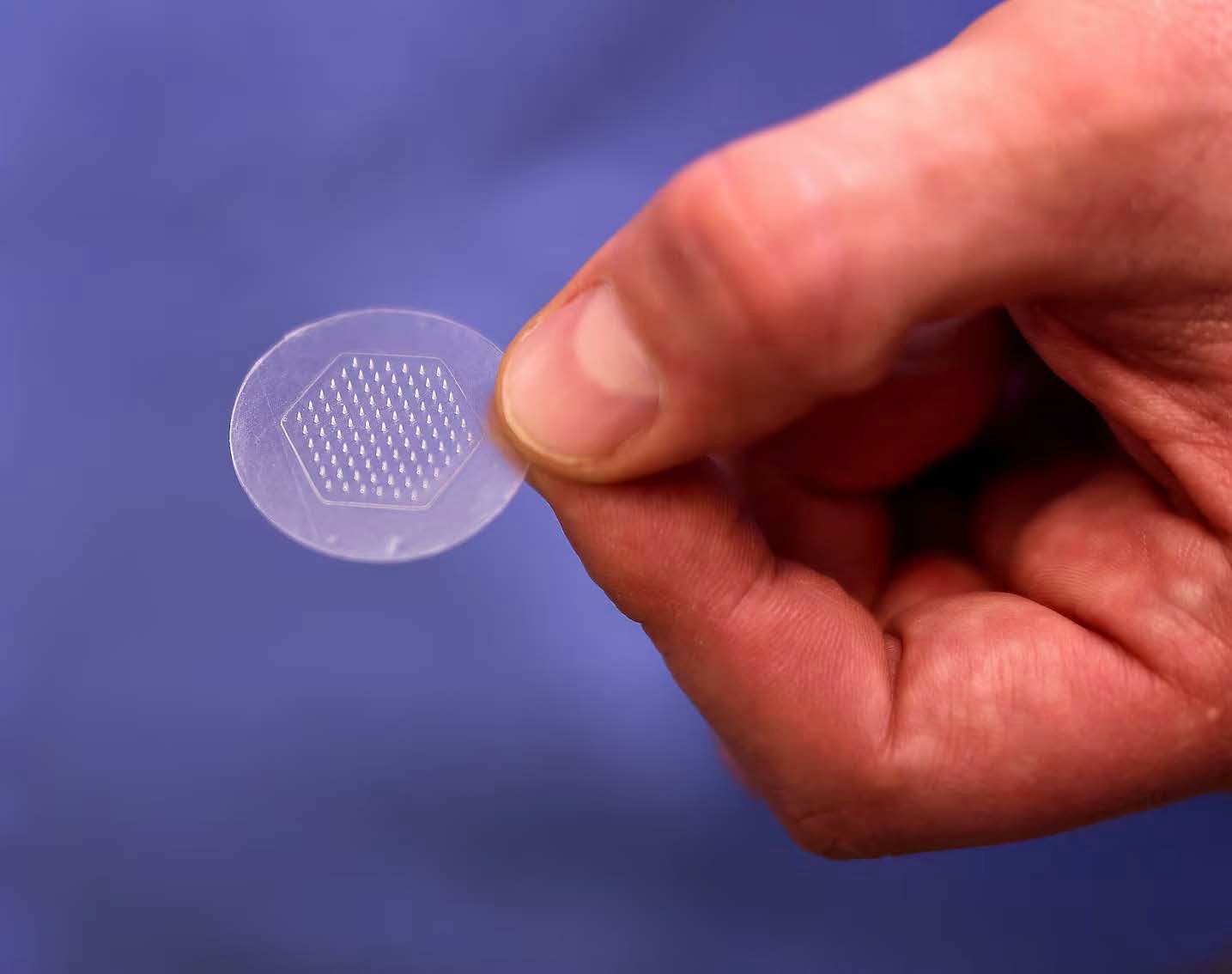 Anodyne’s proprietary technology, the HeroPatch, originally licensed from Tufts University, represents a breakthrough in drug delivery by transdermally delivering multi-miligram dosages of large molecules (up to tens of mg).
The HeroPatch ™ platform enables:
· Tunable Pharmacokinetic Profiles: By tuning to the desired absorption rate, efficacy can be improved while minimizing side effects.
· Optimized delivery of biologics: By utilizing solid-state APIs, we enable the delivery of biologics that normally are not stable in liquid form and would require IV infusions, removing the patient from the clinic, and in some cases offering therapies that would otherwise not make it to market.
· Room Temperature Stability: Resulting in up to 10x cost reduction and 20x plastic reduction compared to the packaging and distribution of pen injections.
· Combination Therapies of next-gen therapeutics: By directly incorporating the solid form of the API, drug load up to 30 mg/patch allows for co-formulation of multiple therapeutics within the same patch.
Core Science:
The HeroPatch™ leverages the natural process of dermal diffusion to deliver therapeutic payloads systemically through the skin using a solid-state microneedle architecture (7).
The HeroPatch: How it work
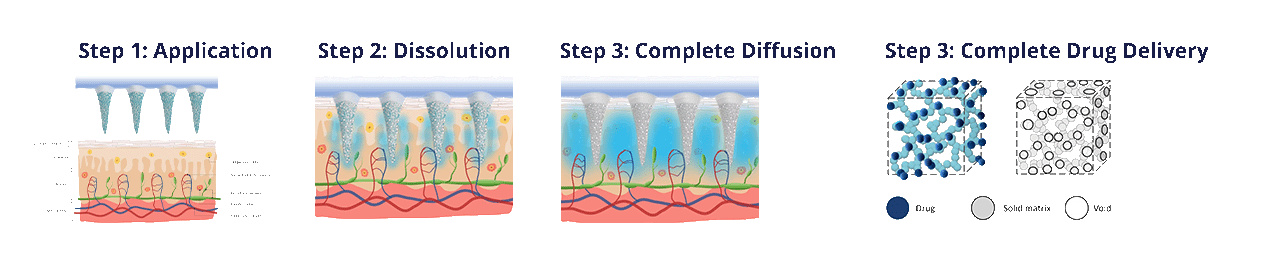
Step 1: Application
The Hero Patch leverages the natural process of diffusion to deliver incredible payloads of medicine through the skin.
Step 2: Dissolution
Once the microneedles are effectively applied on the skin, the surrounding fluid begins to extract the loaded drug molecules.
Step 3: Complete Diffusion
Throughout the process, the structure of the microneedles remains intact to ensure consistent penetration.
Step 4: Complete Drug Delivery and Patch Removal
The drug is fully delivered through systemic uptake, leaving an array of empty microneedles for removal. The polymeric matrix is shown before and after drug release, illustrating how the microneedles deliver only the desired drug.
Anodyne’s intellectual property portfolio combines exclusively licensed patents from Tufts University with internally developed filings. The IP fundamentally covers two core areas:
1. The composition of the new type of microneedles – the high dose platform
2. The process by which the new type of microneedles are made
Additionally, over six years of development, Anodyne has accumulated a confidential body of knowledge on designing, formulating, and making drug-loaded microneedle array patches. Much of this knowledge is non-obvious and had to be determined experimentally. Anodyne has chosen to keep most of this knowledge as trade secrets rather than disseminate it in patent applications.







The global market for peptide therapeutics already exceeds $117 billion annually, with projected double-digit growth over the next decade (8). Much of that expansion is concentrated in chronic diseases requiring sustained, long-term therapy, where improvements in delivery can materially influence adherence, clinical outcomes, and commercial durability.
Anodyne’s initial clinical focus is GLP-1 receptor agonists. This class represents one of the fastest-growing segments of peptide therapeutics, with the market estimated at approximately $65 billion today and projected to reach $170 billion by 2033 (9). The scale and velocity of GLP-1 adoption in obesity and type 2 diabetes highlight both the clinical potential of peptides and the structural limitations of injectable delivery. Importantly, the addressable need remains vastly underserved: of the approximately 934 million people living with obesity worldwide, only about 4 million are currently treated with branded anti-obesity medications—representing less than 1% treatment adoption globally (10).
Despite their efficacy, injectable GLP-1 therapies depend on autoinjector devices, cold-chain distribution, and complex fill-finish infrastructure, all of which increase cost, generate material waste, and create operational constraints across pharmacies and health systems. Real-world adherence further limits impact. While GLP-1 receptor agonists deliver meaningful weight loss, the trade-offs are significant: around 30% of patients drop out within four weeks due to side effects, and 58% discontinue before achieving a clinically relevant outcome within 12 weeks (11). In addition, an estimated 20–40% of weight lost may come from lean muscle rather than fat, raising concerns about long-term metabolic health, durability of benefit, and overall treatment sustainability (12).
In preclinical studies, Anodyne’s HeroPatch semaglutide achieved systemic exposure equivalent to a 3.6 mg subcutaneous injection, exceeding currently marketed doses, with approximately 51% relative bioavailability—roughly 50-fold higher than oral semaglutide formulations, which require absorption enhancers yet achieve limited systemic exposure. If replicated clinically, a once-weekly, self-applied GLP-1 patch with controlled pharmacokinetics could improve tolerability and adherence while offering pharmaceutical partners a differentiated reformulation pathway.
While obesity serves as the initial entry point, HeroPatch is designed as a broader platform compatible with more than 100 peptide and biologic molecules, with development timelines measured in months rather than years. Programs targeting sarcopenia and sarcopenic obesity are advancing in parallel, reinforcing the platform’s applicability beyond a single therapeutic class.
Competitive Landscape
The HeroPatch™ technology sets itself apart from existing MN platforms by addressing two key challenges that have hindered the full realization of MN potential: dosage viability and scalable manufacturing. Traditional MN technologies have been limited to delivering minimal dosages, restricting their application to vaccines or highly potent therapeutics, thereby constraining their clinical and commercial viability. Additionally, the complex manufacturing processes required for MNs, often involving water and solvents, introduce challenges such as heating and drying, which can degrade biologics and dilute the active payload. HeroPatch™ overcomes these barriers through its unique solid-state, porous, polymeric MN design, enabling the incorporation of up to 30mg of active pharmaceutical ingredient (API) per patch. By directly integrating the solid form of the API, HeroPatch™ eliminates the need for water and solvents, ensuring both drug stability and scalable manufacturing, making it an innovative solution for peptide and biologic drug delivery.
Email us today if you are interested in investing in Anodyne Nanotech by clicking the button below.
Anodyne Nanotech employs a dual-path commercialization model that balances near-term revenue generation with long-term platform value creation.
The first pathway centers on high-value strategic partnerships with pharmaceutical companies. Through paid feasibility studies, co-development programs, and exclusive licensing agreements, partners provide both capital and proprietary molecules while Anodyne advances the HeroPatch™ platform for their specific assets. This model has already been validated through revenue-generating engagements with top-10 global pharmaceutical companies, demonstrating strong market interest in high-dose microneedle delivery.
In parallel, Anodyne advances an internal pipeline focused on off-patent metabolic peptides and next-generation combination therapies that benefit most from needle-free, room-temperature, high-dose delivery. This internal portfolio strengthens IP, creates licensable assets, and ensures the company captures downstream value as the platform matures.
Together, these two pathways diversify risk and position the company for scalable, capital-efficient growth.
Anodyne Nanotech employs a dual-path commercialization model that balances near-term revenue generation with long-term platform value creation.
The first pathway centers on high-value strategic partnerships with pharmaceutical companies. Through paid feasibility studies, co-development programs, and exclusive licensing agreements, partners provide both capital and proprietary molecules while Anodyne advances the HeroPatch™ platform for their specific assets. This model has already been validated through revenue-generating engagements with top-10 global pharmaceutical companies, demonstrating strong market interest in high-dose microneedle delivery.
In parallel, Anodyne advances an internal pipeline focused on off-patent metabolic peptides and next-generation combination therapies that benefit most from needle-free, room-temperature, high-dose delivery. This internal portfolio strengthens IP, creates licensable assets, and ensures the company captures downstream value as the platform matures.
Together, these two pathways diversify risk and position the company for scalable, capital-efficient growth.
Pipeline & Results:
Anodyne is advancing a pipeline of transdermal biologic and peptide therapies targeting high-value indications in metabolic disease, endocrinology, and age-related conditions such as obesity and sarcopenia.
Each program leverages HeroPatch™ microneedle platform to enable needle-free, tunable delivery of complex molecules. By tailoring release rates to each molecule’s ideal pharmacokinetic profile, we aim to optimize therapeutic outcomes and address major unmet needs with more accessible, patient-friendly solutions.
ANN-101 (GLP-1 RA) | Indication: Obesity | Stage: IND-enabling to begin Phase I Study Q3 2026
ANN-101 is a once-weekly GLP-1 receptor agonist transdermal patch. Preclinical studies demonstrated multi-milligram delivery of GLP-1, exceeding that of subcutaneous semaglutide injections, without the need for cold-chain logistics. ANN-101 has the potential to minimize gastrointestinal side effects, enhance adherence, and expand global access to obesity therapies.
ANN-102 (APJ RA)| Indication: Sarcopenia | Stage: PK/PD Optimization
ANN-102 is a first-in-class transdermal therapy targeting the APJ receptor to combat muscle loss associated with aging. Daily administration of the APJ-RA via Anodyne’s HeroPatch™ system showed equivalent efficacy to injections in preclinical models, significantly improving muscle strength. This innovation opens a path to safe, convenient interventions for sarcopenia—a growing unmet need in an aging population.
ANN-103 (GLP-1 RA + APJ RA)| Indication: Sarcopenic Obesity | Stage: PK/PD Optimization
ANN-103 is a combination patch delivering GLP-1 and APJ receptor agonists to promote fat loss while preserving muscle mass. It addresses the critical drawback of standalone GLP-1 therapies, which may cause up to 40% of weight loss from lean body mass. ANN-103 offers a dual-action approach to combat sarcopenic obesity, advancing both obesity care and healthy aging.
A monoclonal antibody (mAb) is also advancing into the pipeline.

Summary
Anodyne sits at the intersection of two powerful trends: the rapid expansion of biologic therapeutics and the growing recognition that delivery, not discovery, is the limiting factor in chronic care. With validated preclinical data, revenue-generating pharmaceutical partnerships, and a lead GLP-1 program entering clinical studies in 2026, the company is approaching a meaningful inflection point. HeroPatch™ is designed not simply as a product innovation, but as a platform capable of reshaping how high-value biologics are formulated, stabilized, and delivered. As injectable markets continue to expand globally, Anodyne offers exposure to both near-term clinical catalysts and long-term platform-level value creation across multiple therapeutic categories.
Investment Opportunity
Anodyne Nanatech is raising a $9 million Series A to advance the HeroPatch to commercialization
The funds will be used to conduct a Phase 1 Clinical Study with a once a week GLP-1 RA to demonstrate bioequivalence
Scheduled for Q3 2026
Milestones:
- 1st Commercial Agreement with major pharmaceutical company
- Fully de-risk manufacturing process for commercial volumes
Email us today if you are interested in investing in Anodyne Nanotech by clicking the button below.